Converting underutilized freight rail into a high-capacity passenger transit corridor—without a single mile of new track.
Imagine a new transit line connecting Atlanta’s most vibrant neighborhoods, major employment hubs, and the city’s largest institutions: Emory University, the CDC, Piedmont Hospital, Georgia Tech, and the Mercedes-Benz Stadium—all without sitting in traffic.
It might sound like a pipe dream, but this infrastructure already exists—and it’s hiding in plain sight.
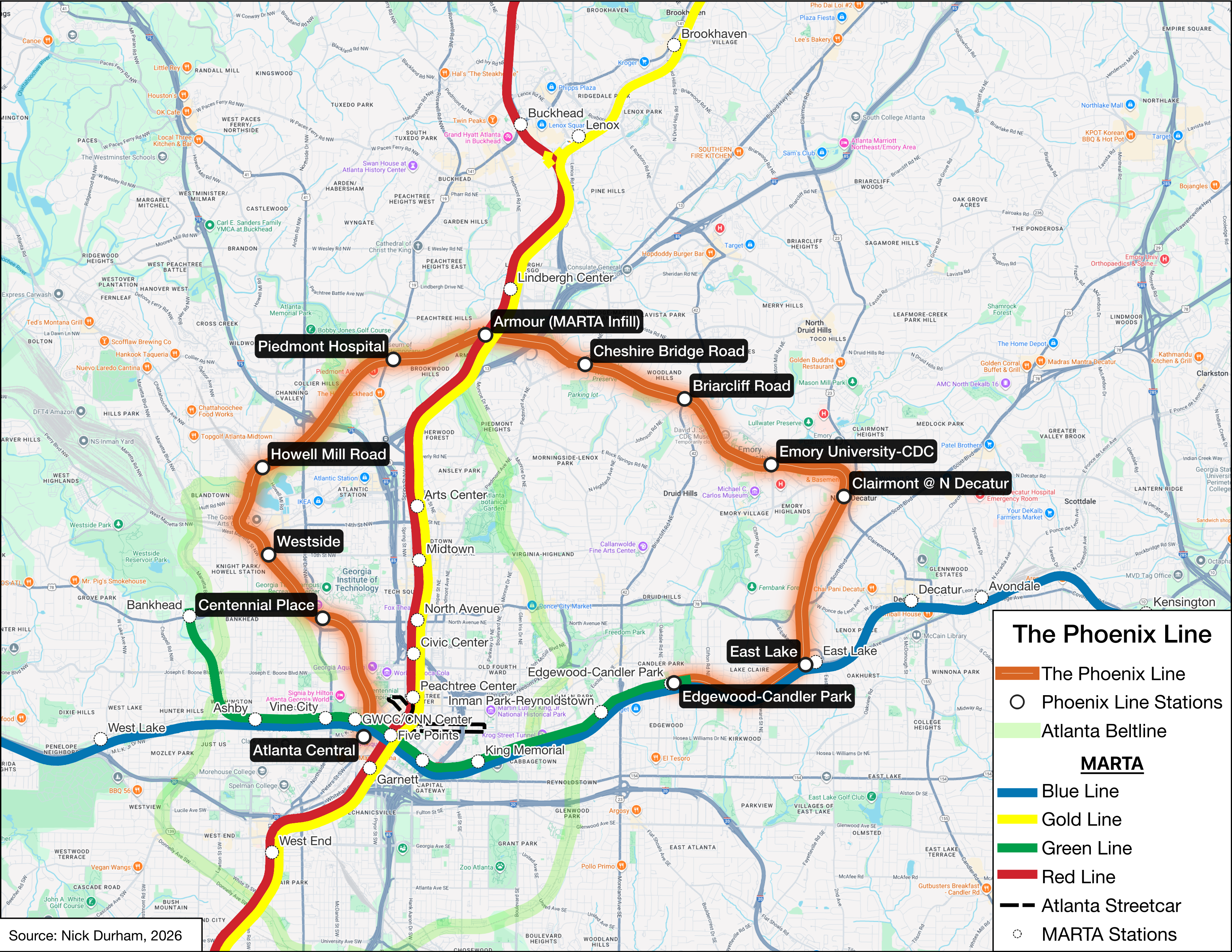
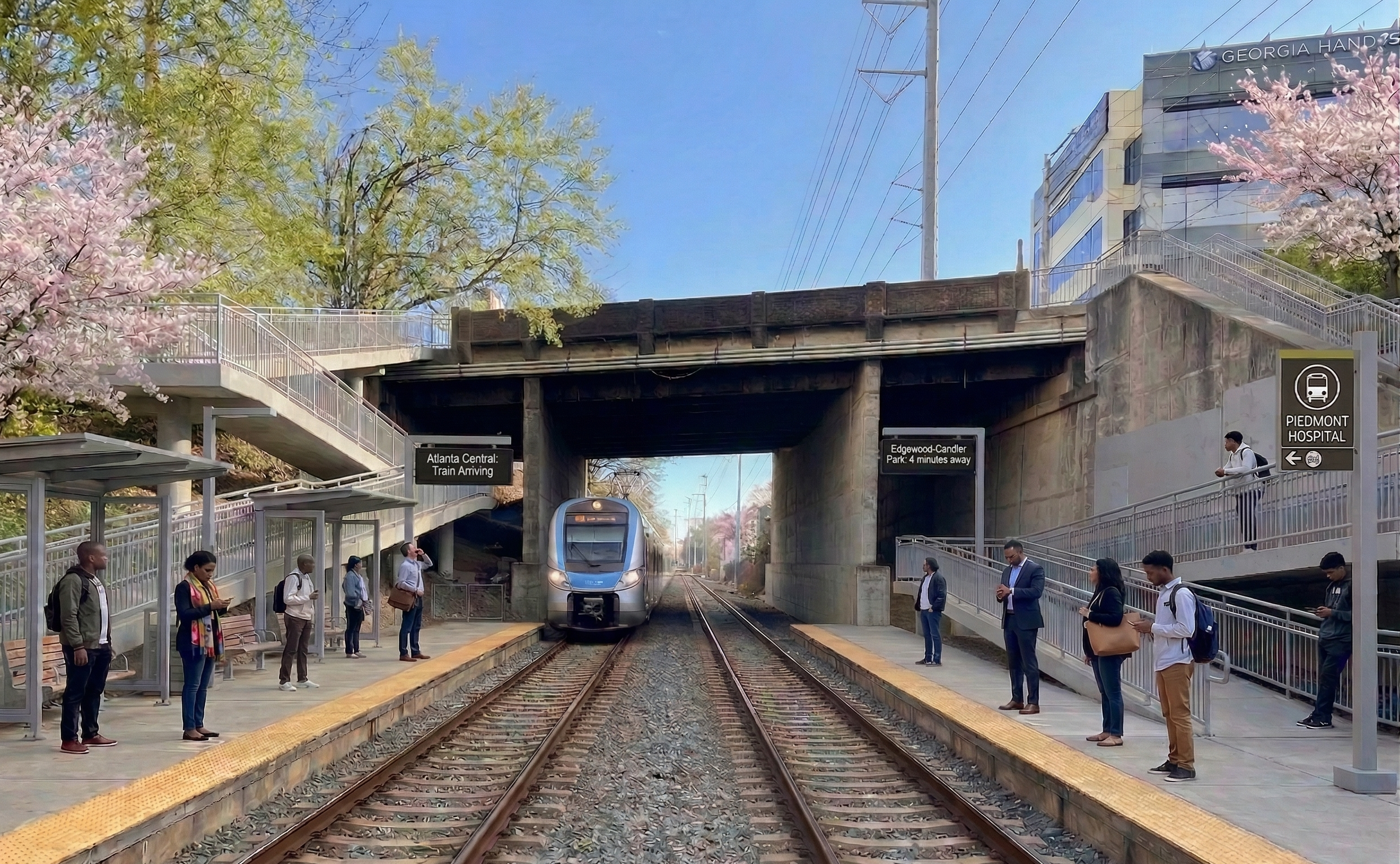
Meet the Phoenix Line: a proposed transit line that converts existing, underutilized freight railroad tracks into a high-capacity passenger corridor. This 12-stop line runs from Edgewood-Candler Park, up to Peachtree Road, and back down through the Westside to downtown.
Whereas net new MARTA rail can cost upwards of $250M per mile, retrofitting existing freight paths—some carrying as few as five trains a day—could reduce that cost by 80%, on par with Bus Rapid Transit. And this system would simultaneously improve our aging freight rail infrastructure.
The Phoenix Line — 12 stations across Atlanta’s underserved transit corridors. Source: Nick Durham, 2026.
The “cars-at-all-costs” approach to urban development carries a truly staggering price tag. Between 2020 and 2024, there were over 394,000 traffic-related injuries in the 11-county metro area. In 2024, traffic fatalities in Atlanta outpaced homicides.
As the nation’s eighth-largest metro area continues to grow, doubling down yields diminishing returns. It is safer and more economically shrewd to invest in modes of transit that can move up to 25,000 people per hour safely, rather than 2,500 people per hour, very riskily.
The antidote lies in re-booting our origin story as a railroad “Terminus.”
Vehicle crashes cost Georgia’s economy $10 billion annually, per the U.S. DOT.
Parking mandates inflate rent costs by nearly 20%, pricing out residents across Atlanta.
25% of downtown Atlanta is consumed by parking—lost tax revenue, lost activation.
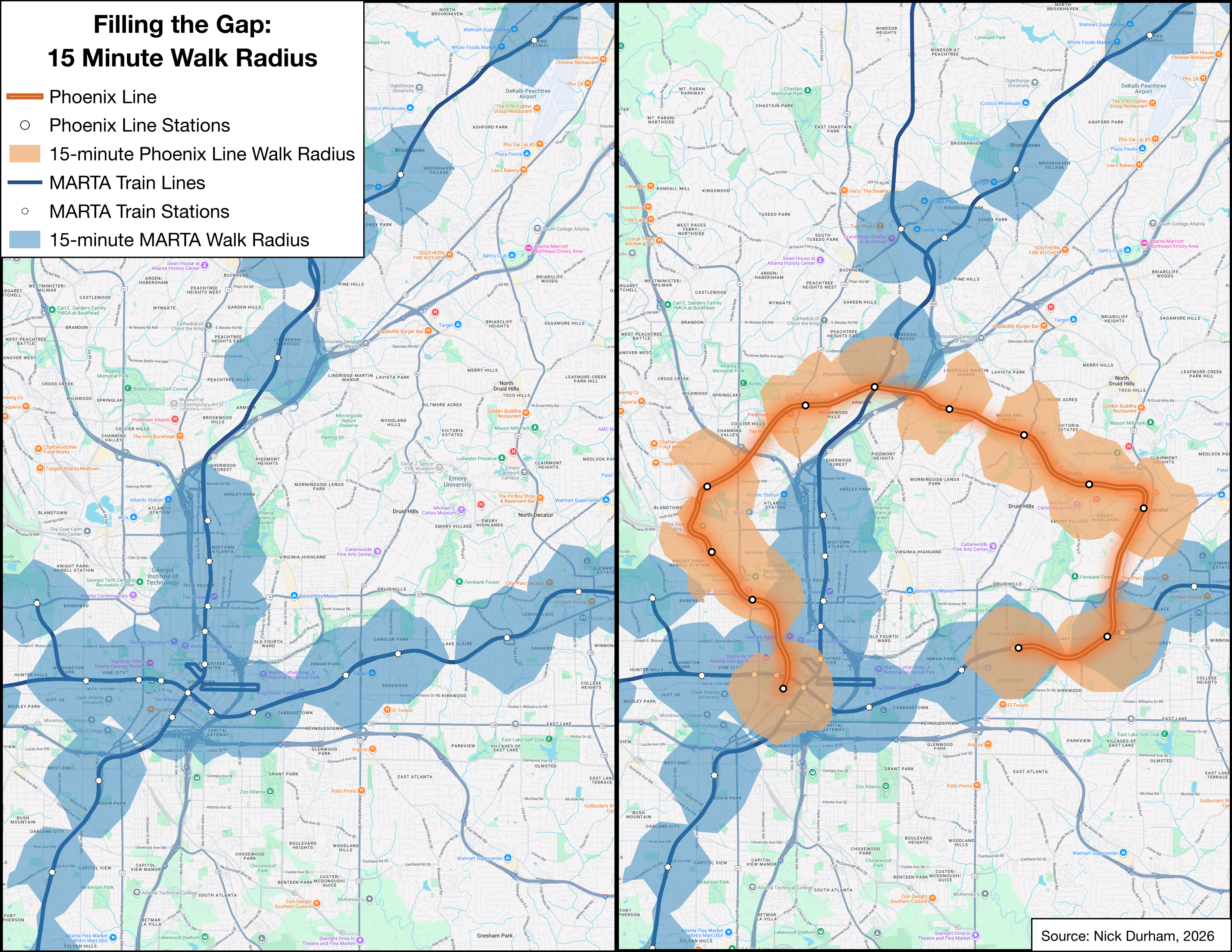
Filling the gap: Phoenix Line 15-min walk radius vs. existing MARTA coverage. Source: Nick Durham, 2026.
Rail conversions like the Phoenix Line offer the best of both worlds: the lower price tag of BRT with the higher capacity, speed, and ridership of rail transit. Rail stations drive economic development in ways even the best BRT stations rarely do.
One study by the National Association of Realtors and APTA found that residential property values within half a mile of rail transit held their value 41.6% better following the 2008 recession. Every dollar invested in public transit provides a long-term impact of five dollars in impacted communities.
Charlotte’s Lynx Blue Line light rail has attracted $2.8 billion in private development. The Phoenix Line would do the same for Atlanta.
“The key to Atlanta’s metamorphosis in the 21st century isn’t adding another lane—it’s adding another train.”
The Phoenix Line is a starting point. This strategy scales powerfully across metro Atlanta.
Only 15% of the metro area currently lives within a 15-minute drive of a train station.
Retrofitting the region’s underutilized freight corridors could skyrocket coverage to 85% of the population.
A full Resurgens network would make Atlanta the fourth-busiest transit system in the nation, behind only New York, New Jersey, and Chicago.
“Atlanta does not have to choose between growth and livability. The key to Atlanta’s metamorphosis in the 21st century isn’t adding another lane—it’s adding another train.”
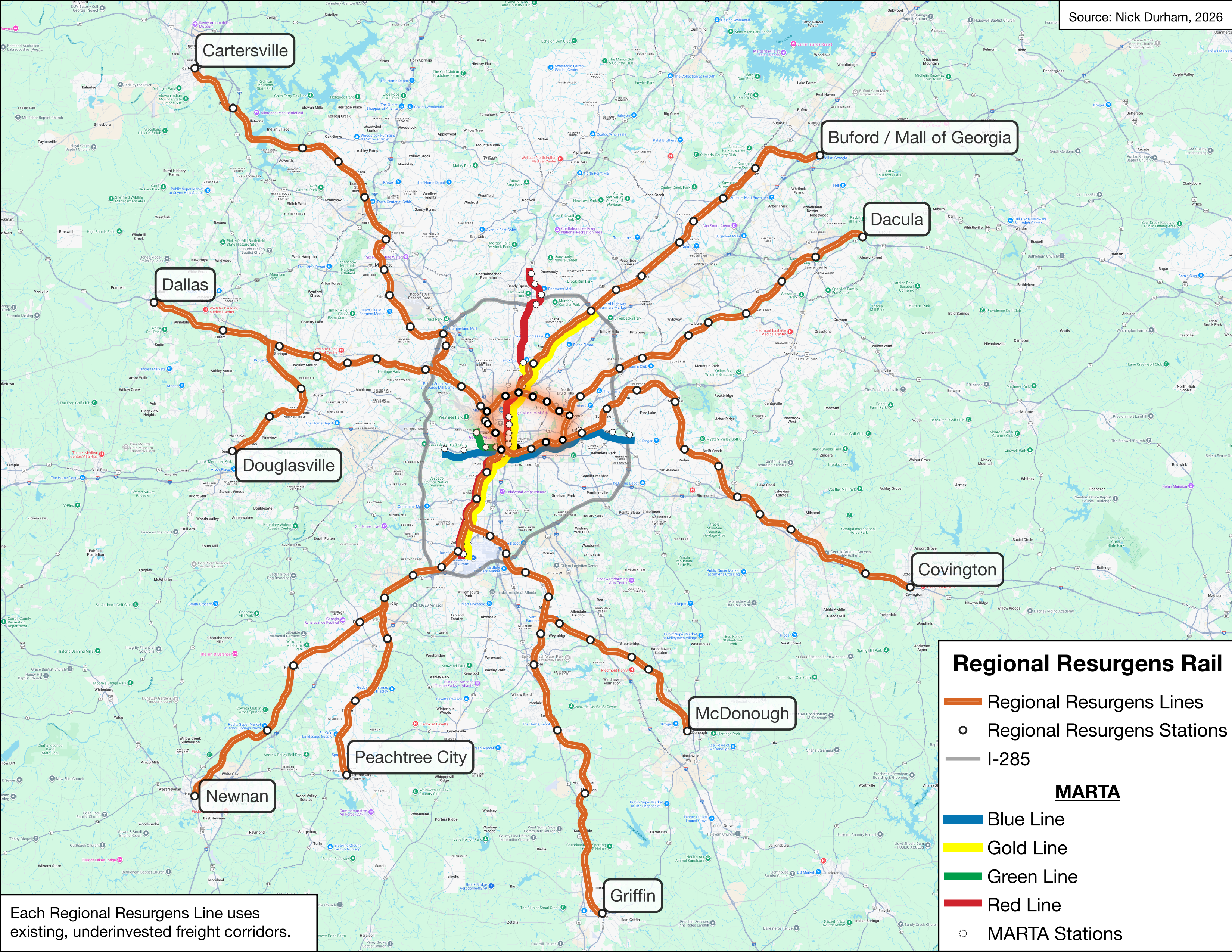
Because Atlanta and its suburbs were initially built alongside rail lines, unlocking these tracks creates the backbone for a vast future regional commuter network—the Resurgens Rail Network (“the Surge”).
Imagine residents in Lawrenceville riding to their job at Hartsfield-Jackson, or residents in Douglasville taking the train to the CDC. The infrastructure is already there.
Current plans like the proposed I-285 Top-End “Express Lanes” will not ease traffic long-term. A projected 76% surge in regional freight traffic by 2040 makes rail modernization urgent for passengers and shippers alike.
The Resurgens (“Surge”) Network—all using existing freight infrastructure. Source: Nick Durham, 2026.
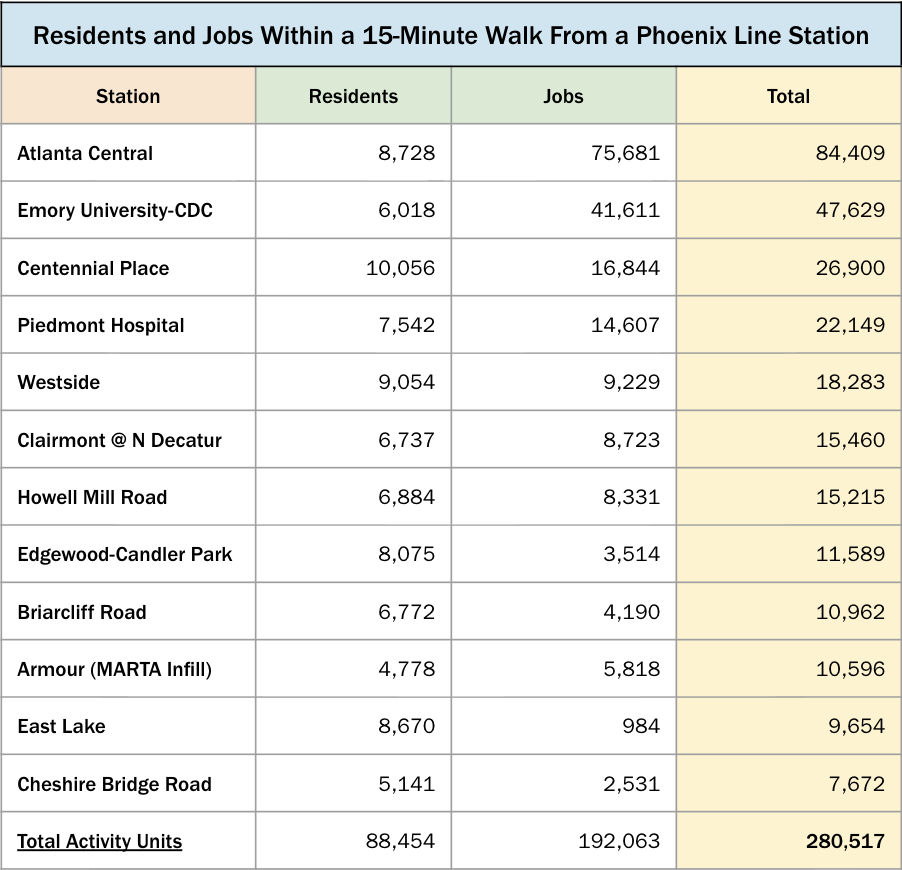
The Twin Cities Metropolitan Council sets the minimum viable threshold for a transit station at 7,000 activity units. Every Phoenix Line station far exceeds that bar—using 2023 ACS and LODES data.
Data: 2023 ACS & LODES datasets. Analysis: Nick Durham, 2026.
Funding transit expansion requires political will and creativity, but the path is proven—even in economically uncertain times.
Metro Denver passed a 0.04% regional sales tax. Despite a major recession, eight train lines were operational 16 years later. Denver RTD reports 15,000 full-time jobs created since 2005.
Hong Kong’s property-based revenue schemes help transit fund itself without subsidies—similar to the Tax Allocation District mechanism already providing 75% of the Beltline’s budget.
Within a half-mile of the line: Piedmont Hospital, Emory, Georgia Tech. These institutions benefit directly and should be key stakeholders—including PILOT contributions from tax-exempt institutions like Mercedes-Benz Stadium.
Atlanta has the eighth-largest concentration of Fortune 500 companies in the U.S. Between the 1996 Olympics and the Beltline, the city has proven it can galvanize private money for public good.
Some lines carry just five trains a day while Howell Junction handles 66. Other corridors are physically underbuilt with one track despite having space for four. Failing to modernize means more freight on highways—in a metro already home to three of the ten worst truck bottlenecks in the country.
Strategic partnerships with freight operators to modernize signals and expand trackage would simultaneously enhance both freight and passenger networks—maximizing return on investment for all parties.
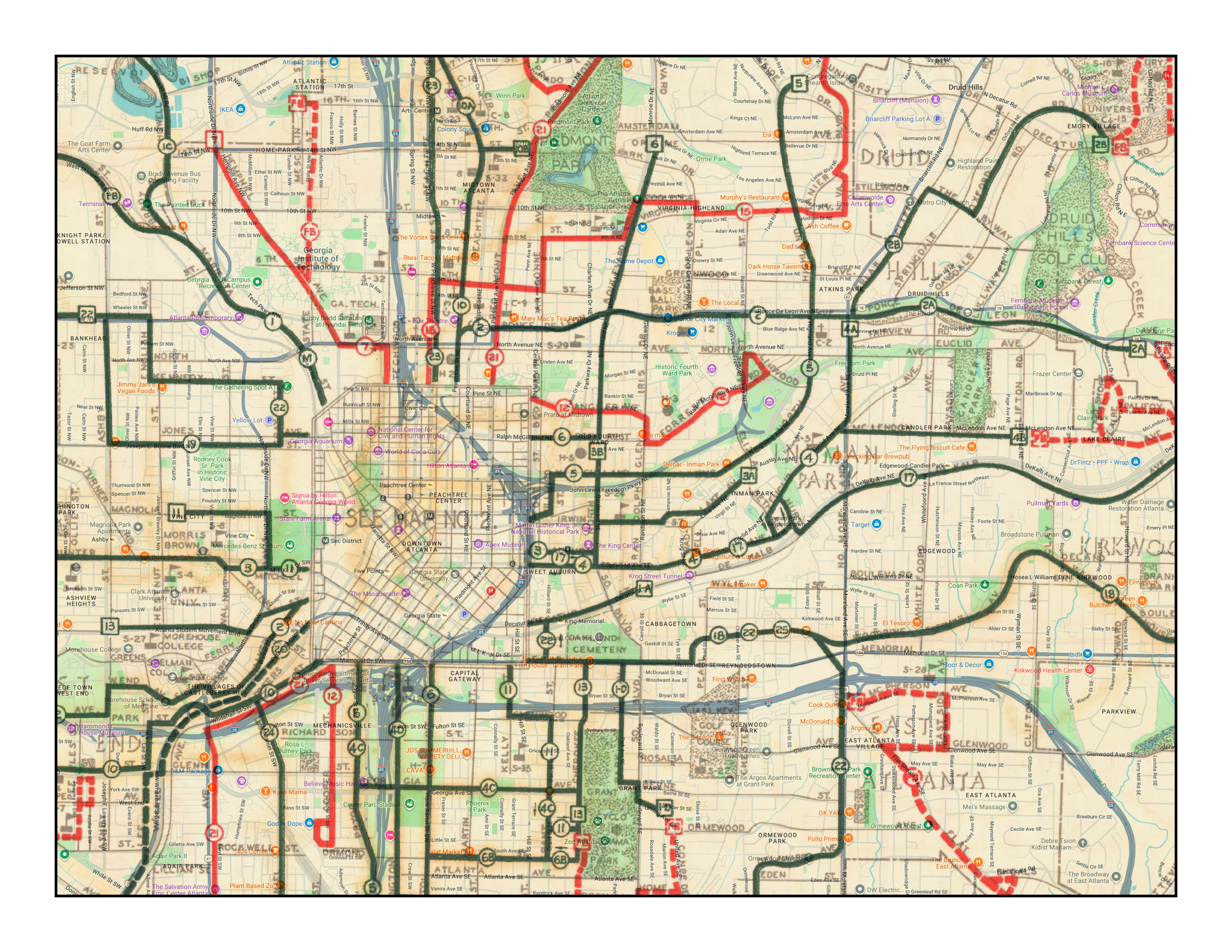
Atlanta’s streetcars, pictured right, ran from the 1870s to 1949—nearly 80 years. Our current experiment with highway-boosted car dominance, beginning in the 1950s, has now lasted roughly the same amount of time.
Building new transit is far more realistic than expecting more asphalt to improve livability in a quickly growing city. Atlanta’s existing rail infrastructure gives it an unusual head start.
A future beyond cars-at-all-costs is freer, healthier, and more vibrant. Atlanta is defined by reinvention. The Phoenix Line is a critical, urgent step toward closing that gap.
Atlanta’s historic streetcar network, ca. 1950—a legacy awaiting its next chapter.
Nick Durham is enrolled in a dual MBA–Master of City Planning program at MIT and also works for Invest Atlanta. Nick holds a B.A. in History from Harvard University and has prior experience at public-private partnership focused startups in the waste re-use and climate technology industries. Most importantly, he was born and raised in Atlanta.
ndurham@mit.edu